
By, Roger Stone
Long before luxury watches, bespoke shoes, or hand rolled pocket squares became the calling cards of a well dressed man, there was another accessory quietly performing one of the most important jobs in menswear: suspenders. Today they are often viewed as a statement of style, confidence, and old world sophistication. Yet suspenders were never created to attract attention. They were invented to solve a practical problem.
The modern suspender owes its existence to British haberdasher Albert Thurston, who introduced what he called “braces” in London in 1822. Thurston recognized that the high waisted trousers worn by gentlemen of the era were poorly suited to belts. A belt positioned at the natural waist was uncomfortable, unattractive, and often ineffective. Suspenders allowed trousers to hang properly from the shoulders, creating a cleaner line and a more elegant silhouette. The concept itself, however, was older. French aristocrats during the reign of King Louis XVI used simple fabric straps known as bretelles to support breeches and trousers. These early versions were hidden beneath coats and waistcoats because suspenders were considered underwear, not something intended for public display.
For much of the 19th century, nearly every well-dressed man wore them. As tailoring improved and ready made clothing became widely available during the Industrial Revolution, suspenders became indispensable. They allowed trousers to drape naturally without bunching at the waist. Doctors even recommended them over belts for heavier men because they avoided unnecessary pressure on the abdomen.
America added its own chapter to the story when Samuel Clemens, better known as celebrated author Mark Twain, patented an adjustable suspender design in 1871. Practicality remained the driving force, but fashion was already beginning to take notice. The transformation from utility to style occurred gradually. During the late 19th century men increasingly removed their jackets during warm weather, exposing what had previously remained hidden. Suspenders suddenly became visible. By the early 20th century they were no longer merely functional devices. They had become part of a gentleman’s overall presentation.
Their dominance began to fade after the First World War. Military uniforms familiarized millions of men with belts, and trouser waists gradually moved lower. Belts became fashionable and convenient. Suspenders never disappeared, but they became the choice of men who appreciated traditional tailoring rather than following passing trends.
That exclusivity eventually became part of their appeal. From financiers on Wall Street to lawyers, broadcasters, politicians, and movie stars, suspenders came to signal confidence and authority. They suggested a man who understood the difference between fashion and style. Fashion changes. Style endures.
An excellent pair of suspenders is a remarkable piece of craftsmanship. The finest examples are made with natural rubber elastic that retains its strength for decades. They feature full grain leather ends, polished brass hardware, hand finished stitching, and precisely engineered adjusters that hold their position without slipping. The best suspenders distribute tension evenly across the shoulders, preventing twisting or sagging while remaining virtually unnoticeable to the wearer. Like a quality necktie or handmade shoes, a superior pair of suspenders is often a lifelong purchase rather than a seasonal accessory. Traditionalists strongly prefer button suspenders attached to buttons sewn inside the waistband of properly tailored trousers. They provide a cleaner appearance and superior comfort. Clip on versions serve a purpose for casual wear, but they lack the refinement associated with classic menswear.
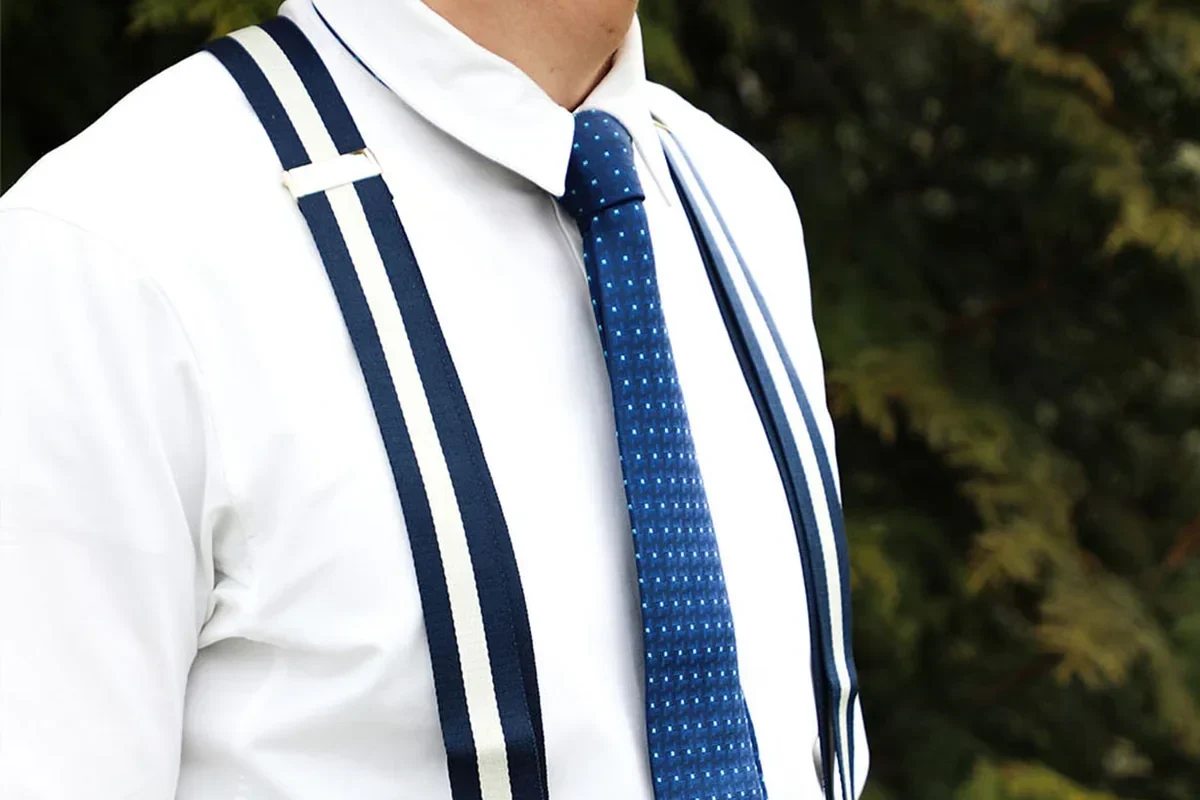
The rules for wearing suspenders today remain simple. Never wear them with a belt. Both perform the same function, and combining them suggests confusion rather than sophistication. Trousers should sit at the natural waist rather than low on the hips. Shirts should be tucked in cleanly, allowing the suspenders to create an uninterrupted vertical line from shoulder to waistband. For business attire, navy, charcoal, burgundy, and black remain timeless choices. With formal evening wear, black silk button suspenders are the gold standard. For more casual settings, subtle stripes, woven textures, and earth tones can add personality without appearing theatrical.
Perhaps the enduring appeal of suspenders lies in what they communicate. They reveal an appreciation for craftsmanship, tradition, and attention to detail. They remind us that true elegance often begins with the things most people overlook. That is why, more than two centuries after Albert Thurston introduced his invention to London’s gentlemen, suspenders remain one of the smartest investments a man can make. They hold up more than trousers. They uphold a standard.